Author: guillaume

  • Gateway, Cloudflare One – Network Session Logs now available for all on-ramps

    Zero Trust Network Session Logs are now generated for all traffic proxied through Cloudflare Gateway, regardless of on-ramp type. This includes traffic from proxy endpoints (PAC files) and Browser Isolation egress — on-ramps that previously did not generate session logs.

    Customers who already consume the zero_trust_network_sessions dataset via Logpush or Log Explorer may see increased log volume if they use these on-ramps.

    For field definitions, refer to Zero Trust Network Session Logs. For traffic analysis, refer to Network session analytics.

  • Audit Logs – Audit Logs v2 — Organization-level support

    Audit Logs v2 now supports organization-level audit logs. Org Admins can retrieve audit events for actions performed at the organization level via the Audit Logs v2 API.

    To retrieve organization-level audit logs, use the following endpoint:

    GET https://api.cloudflare.com/client/v4/organizations/{organization_id}/logs/audit

    This release covers user-initiated actions performed through organization-level APIs. Audit logs for system-initiated actions, a dashboard UI, and Logpush support for organizations will be added in future releases.

    For more information, refer to the Audit Logs documentation.

  • Audit Logs – Audit Logs v2 — Organization-level support

    Audit Logs v2 now supports organization-level audit logs. Org Admins can retrieve audit events for actions performed at the organization level via the Audit Logs v2 API.

    To retrieve organization-level audit logs, use the following endpoint:

    GET https://api.cloudflare.com/client/v4/organizations/{organization_id}/logs/audit

    This release covers user-initiated actions performed through organization-level APIs. Audit logs for system-initiated actions, a dashboard UI, and Logpush support for organizations will be added in future releases.

    For more information, refer to the Audit Logs documentation.

  • SDK, Go SDK – Go SDK v6.10.0 Released

    v6.10.0

    In this release, you’ll see a number of breaking changes. This is primarily due to changes in OpenAPI definitions, which our libraries are based off of, and codegen updates that we rely on to read those OpenAPI definitions and produce our SDK libraries.

    Please ensure you read through the list of changes below before moving to this version – this will help you understand any down or upstream issues it may cause to your environments.

    Breaking Changes

    See the v6.10.0 Migration Guide for before/after code examples and actions needed for each change.

    Abuse Reports – Registrar WHOIS Report Field Removals

    Several fields have been removed from AbuseReportNewParamsBodyAbuseReportsRegistrarWhoisReportRegWhoRequest:

    • RegWhoGoodFaithAffirmation
    • RegWhoLawfulProcessingAgreement
    • RegWhoLegalBasis
    • RegWhoRequestType
    • RegWhoRequestedDataElements

    AI Search – Instance Params Restructured

    The InstanceNewParams and InstanceUpdateParams types have been significantly restructured. Many fields have been moved or removed:

    • InstanceNewParams.TokenID, Type, CreatedFromAISearchWizard, WorkerDomain removed
    • InstanceUpdateParams — most configuration fields removed (including IndexMethod, IndexingOptions, MaxNumResults, Metadata, Paused, PublicEndpointParams, Reranking, RerankingModel, RetrievalOptions, RewriteModel, RewriteQuery, ScoreThreshold, SourceParams, Summarization, SummarizationModel, SystemPromptAISearch, SystemPromptIndexSummarization, SystemPromptRewriteQuery, TokenID, CreatedFromAISearchWizard, WorkerDomain)
    • InstanceSearchParams.Messages field removed along with InstanceSearchParamsMessage and InstanceSearchParamsMessagesRole types

    AI Search – InstanceItem Service Removed

    The InstanceItemService type has been removed. The items sub-resource at client.AISearch.Instances.Items no longer exists in the non-namespace path. Use client.AISearch.Namespaces.Instances.Items instead.

    AI Search – Token Types Removed

    The following types have been removed from the ai_search package:

    • TokenDeleteResponse
    • TokenListParams (and associated TokenListParamsOrderBy, TokenListParamsOrderByDirection)

    Email Security – Investigate Move Return Type Change

    The Investigate.Move.New() method now returns a raw slice instead of a paginated wrapper:

    • New() returns *[]InvestigateMoveNewResponse instead of *pagination.SinglePage[InvestigateMoveNewResponse]
    • NewAutoPaging() method removed

    Hyperdrive – Config Params Restructured

    The ConfigEditParams type lost its MTLS and Name fields. The HyperdriveMTLSParam type lost MTLS and Host fields. The Host field on origin config changed from param.Field[string] to a plain string.

    IAM – UserGroupMember Params and Return Types Changed

    The UserGroupMemberNewParams struct has been restructured and the New() method now returns a paginated response:

    • UserGroupMemberNewParams.Body renamed to UserGroupMemberNewParams.Members
    • UserGroupMemberNewParamsBody renamed to UserGroupMemberNewParamsMember
    • UserGroupMemberUpdateParams.Body renamed to UserGroupMemberUpdateParams.Members
    • UserGroupMemberUpdateParamsBody renamed to UserGroupMemberUpdateParamsMember
    • UserGroups.Members.New() returns *pagination.SinglePage[UserGroupMemberNewResponse] instead of *UserGroupMemberNewResponse

    IAM – UserGroup List Direction Type Changed

    The UserGroupListParams.Direction field changed from param.Field[string] to param.Field[UserGroupListParamsDirection] (typed enum with asc/desc values).

    Pipelines – Delete Methods Now Return Typed Responses

    Several delete methods across Pipelines now return typed responses instead of bare error:

    • Pipelines.DeleteV1() returns (*PipelineDeleteV1Response, error) instead of error
    • Pipelines.Sinks.Delete() returns (*SinkDeleteResponse, error) instead of error
    • Pipelines.Streams.Delete() returns (*StreamDeleteResponse, error) instead of error

    Queues – Message Response Types Removed

    The following response envelope types have been removed:

    • MessageBulkPushResponseSuccess
    • MessagePushResponseSuccess
    • MessageAckResponse fields RetryCount and Warnings removed

    Secrets Store – Pagination Wrapper Removal and Type Changes

    Methods now return direct types instead of SinglePage wrappers, and several internal types have been removed. Associated AutoPaging methods have also been removed:

    • Stores.New() returns *StoreNewResponse instead of *pagination.SinglePage[StoreNewResponse]
    • Stores.NewAutoPaging() method removed
    • Stores.Secrets.BulkDelete() returns *StoreSecretBulkDeleteResponse instead of *pagination.SinglePage[StoreSecretBulkDeleteResponse]
    • Stores.Secrets.BulkDeleteAutoPaging() method removed
    • Removed types: StoreDeleteResponse, StoreDeleteResponseEnvelopeResultInfo, StoreSecretDeleteResponse, StoreSecretDeleteResponseStatus, StoreSecretBulkDeleteResponse (old shape), StoreSecretBulkDeleteResponseStatus, StoreSecretDeleteResponseEnvelopeResultInfo
    • StoreNewParams restructured (old StoreNewParamsBody removed)
    • StoreSecretBulkDeleteParams restructured

    Stream – AudioTracks Return Type Change

    The AudioTracks.Get() method now returns a dedicated response type instead of a paginated list. The GetAutoPaging() method has been removed:

    • Get() returns *AudioTrackGetResponse instead of *pagination.SinglePage[Audio]
    • GetAutoPaging() method removed

    Stream – Clip Type Removal and Return Type Change

    The Clip.New() method now returns the shared Video type. The following types have been entirely removed:

    • Clip, ClipPlayback, ClipStatus, ClipWatermark

    Stream – Copy and Clip Params Field Removals

    • ClipNewParams.MaxDurationSeconds, ThumbnailTimestampPct, Watermark removed
    • CopyNewParams.ThumbnailTimestampPct, Watermark removed

    Stream – Download and Webhook Changes

    • DownloadNewResponseStatus type removed
    • WebhookUpdateResponse and WebhookGetResponse changed from interface{} type aliases to full struct types

    Zero Trust – Access AI Control MCP Portal Union Types Removed

    The following union interface types have been removed:

    • AccessAIControlMcpPortalListResponseServersUpdatedPromptsUnion
    • AccessAIControlMcpPortalListResponseServersUpdatedToolsUnion
    • AccessAIControlMcpPortalReadResponseServersUpdatedPromptsUnion
    • AccessAIControlMcpPortalReadResponseServersUpdatedToolsUnion

    Features

    Vulnerability Scanner (client.VulnerabilityScanner)

    NEW SERVICE: Full vulnerability scanning management

    • CredentialSets – CRUD for credential sets (New, Update, List, Delete, Edit, Get)
    • Credentials – Manage credentials within sets (New, Update, List, Delete, Edit, Get)
    • Scans – Create and manage vulnerability scans (New, List, Get)
    • TargetEnvironments – Manage scan target environments (New, Update, List, Delete, Edit, Get)

    AI Search – Namespaces (client.AISearch.Namespaces)

    NEW SERVICE: Namespace-scoped AI Search management

    • New(), Update(), List(), Delete(), ChatCompletions(), Read(), Search()
    • Instances – Namespace-scoped instances (New, Update, List, Delete, ChatCompletions, Read, Search, Stats)
    • Jobs – Instance job management (New, Update, List, Get, Logs)
    • Items – Instance item management (List, Delete, Chunks, NewOrUpdate, Download, Get, Logs, Sync, Upload)

    Browser Rendering – Devtools (client.BrowserRendering.Devtools)

    NEW SERVICE: DevTools protocol browser control

    • Session – List and get devtools sessions
    • Browser – Browser lifecycle management (New, Delete, Connect, Launch, Protocol, Version)
    • Page – Get page by target ID
    • Targets – Manage browser targets (New, List, Activate, Get)

    Registrar (client.Registrar)

    NEW: Domain check and search endpoints

    • Check()POST /accounts/{account_id}/registrar/domain-check
    • Search()GET /accounts/{account_id}/registrar/domain-search

    NEW: Registration management (client.Registrar.Registrations)

    • New(), List(), Edit(), Get()
    • RegistrationStatus.Get() – Get registration workflow status
    • UpdateStatus.Get() – Get update workflow status

    Cache – Origin Cloud Regions (client.Cache.OriginCloudRegions)

    NEW SERVICE: Manage origin cloud region configurations

    • New(), List(), Delete(), BulkDelete(), BulkEdit(), Edit(), Get(), SupportedRegions()

    Zero Trust – DLP Settings (client.ZeroTrust.DLP.Settings)

    NEW SERVICE: DLP settings management

    • Update(), Delete(), Edit(), Get()

    Radar

    • AgentReadiness.Summary() – Agent readiness summary by dimension
    • AI.MarkdownForAgents.Summary() – Markdown-for-agents summary
    • AI.MarkdownForAgents.Timeseries() – Markdown-for-agents timeseries

    IAM (client.IAM)

    • UserGroups.Members.Get() – Get details of a specific member in a user group
    • UserGroups.Members.NewAutoPaging() – Auto-paging variant for adding members
    • UserGroups.NewParams.Policies changed from required to optional

    Bot Management

    • ContentBotsProtection field added to BotFightModeConfiguration and SubscriptionConfiguration (block/disabled)

    Deprecations

    None in this release.

    Get started
  • Audit Logs – Audit Logs v2 — Organization-level support

    Audit Logs v2 now supports organization-level audit logs. Org Admins can retrieve audit events for actions performed at the organization level via the Audit Logs v2 API.

    To retrieve organization-level audit logs, use the following endpoint:

    GET https://api.cloudflare.com/client/v4/organizations/{organization_id}/logs/audit

    This release covers user-initiated actions performed through organization-level APIs. Audit logs for system-initiated actions, a dashboard UI, and Logpush support for organizations will be added in future releases.

    For more information, refer to the Audit Logs documentation.

  • Audit Logs – Audit Logs v2 — Organization-level support

    Audit Logs v2 now supports organization-level audit logs. Org Admins can retrieve audit events for actions performed at the organization level via the Audit Logs v2 API.

    To retrieve organization-level audit logs, use the following endpoint:

    GET https://api.cloudflare.com/client/v4/organizations/{organization_id}/logs/audit

    This release covers user-initiated actions performed through organization-level APIs. Audit logs for system-initiated actions, a dashboard UI, and Logpush support for organizations will be added in future releases.

    For more information, refer to the Audit Logs documentation.

  • SDK, Go SDK – Go SDK v6.10.0 Released

    v6.10.0

    In this release, you’ll see a number of breaking changes. This is primarily due to changes in OpenAPI definitions, which our libraries are based off of, and codegen updates that we rely on to read those OpenAPI definitions and produce our SDK libraries.

    Please ensure you read through the list of changes below before moving to this version – this will help you understand any down or upstream issues it may cause to your environments.

    Breaking Changes

    See the v6.10.0 Migration Guide for before/after code examples and actions needed for each change.

    Abuse Reports – Registrar WHOIS Report Field Removals

    Several fields have been removed from AbuseReportNewParamsBodyAbuseReportsRegistrarWhoisReportRegWhoRequest:

    • RegWhoGoodFaithAffirmation
    • RegWhoLawfulProcessingAgreement
    • RegWhoLegalBasis
    • RegWhoRequestType
    • RegWhoRequestedDataElements

    AI Search – Instance Params Restructured

    The InstanceNewParams and InstanceUpdateParams types have been significantly restructured. Many fields have been moved or removed:

    • InstanceNewParams.TokenID, Type, CreatedFromAISearchWizard, WorkerDomain removed
    • InstanceUpdateParams — most configuration fields removed (including IndexMethod, IndexingOptions, MaxNumResults, Metadata, Paused, PublicEndpointParams, Reranking, RerankingModel, RetrievalOptions, RewriteModel, RewriteQuery, ScoreThreshold, SourceParams, Summarization, SummarizationModel, SystemPromptAISearch, SystemPromptIndexSummarization, SystemPromptRewriteQuery, TokenID, CreatedFromAISearchWizard, WorkerDomain)
    • InstanceSearchParams.Messages field removed along with InstanceSearchParamsMessage and InstanceSearchParamsMessagesRole types

    AI Search – InstanceItem Service Removed

    The InstanceItemService type has been removed. The items sub-resource at client.AISearch.Instances.Items no longer exists in the non-namespace path. Use client.AISearch.Namespaces.Instances.Items instead.

    AI Search – Token Types Removed

    The following types have been removed from the ai_search package:

    • TokenDeleteResponse
    • TokenListParams (and associated TokenListParamsOrderBy, TokenListParamsOrderByDirection)

    Email Security – Investigate Move Return Type Change

    The Investigate.Move.New() method now returns a raw slice instead of a paginated wrapper:

    • New() returns *[]InvestigateMoveNewResponse instead of *pagination.SinglePage[InvestigateMoveNewResponse]
    • NewAutoPaging() method removed

    Hyperdrive – Config Params Restructured

    The ConfigEditParams type lost its MTLS and Name fields. The HyperdriveMTLSParam type lost MTLS and Host fields. The Host field on origin config changed from param.Field[string] to a plain string.

    IAM – UserGroupMember Params and Return Types Changed

    The UserGroupMemberNewParams struct has been restructured and the New() method now returns a paginated response:

    • UserGroupMemberNewParams.Body renamed to UserGroupMemberNewParams.Members
    • UserGroupMemberNewParamsBody renamed to UserGroupMemberNewParamsMember
    • UserGroupMemberUpdateParams.Body renamed to UserGroupMemberUpdateParams.Members
    • UserGroupMemberUpdateParamsBody renamed to UserGroupMemberUpdateParamsMember
    • UserGroups.Members.New() returns *pagination.SinglePage[UserGroupMemberNewResponse] instead of *UserGroupMemberNewResponse

    IAM – UserGroup List Direction Type Changed

    The UserGroupListParams.Direction field changed from param.Field[string] to param.Field[UserGroupListParamsDirection] (typed enum with asc/desc values).

    Pipelines – Delete Methods Now Return Typed Responses

    Several delete methods across Pipelines now return typed responses instead of bare error:

    • Pipelines.DeleteV1() returns (*PipelineDeleteV1Response, error) instead of error
    • Pipelines.Sinks.Delete() returns (*SinkDeleteResponse, error) instead of error
    • Pipelines.Streams.Delete() returns (*StreamDeleteResponse, error) instead of error

    Queues – Message Response Types Removed

    The following response envelope types have been removed:

    • MessageBulkPushResponseSuccess
    • MessagePushResponseSuccess
    • MessageAckResponse fields RetryCount and Warnings removed

    Secrets Store – Pagination Wrapper Removal and Type Changes

    Methods now return direct types instead of SinglePage wrappers, and several internal types have been removed. Associated AutoPaging methods have also been removed:

    • Stores.New() returns *StoreNewResponse instead of *pagination.SinglePage[StoreNewResponse]
    • Stores.NewAutoPaging() method removed
    • Stores.Secrets.BulkDelete() returns *StoreSecretBulkDeleteResponse instead of *pagination.SinglePage[StoreSecretBulkDeleteResponse]
    • Stores.Secrets.BulkDeleteAutoPaging() method removed
    • Removed types: StoreDeleteResponse, StoreDeleteResponseEnvelopeResultInfo, StoreSecretDeleteResponse, StoreSecretDeleteResponseStatus, StoreSecretBulkDeleteResponse (old shape), StoreSecretBulkDeleteResponseStatus, StoreSecretDeleteResponseEnvelopeResultInfo
    • StoreNewParams restructured (old StoreNewParamsBody removed)
    • StoreSecretBulkDeleteParams restructured

    Stream – AudioTracks Return Type Change

    The AudioTracks.Get() method now returns a dedicated response type instead of a paginated list. The GetAutoPaging() method has been removed:

    • Get() returns *AudioTrackGetResponse instead of *pagination.SinglePage[Audio]
    • GetAutoPaging() method removed

    Stream – Clip Type Removal and Return Type Change

    The Clip.New() method now returns the shared Video type. The following types have been entirely removed:

    • Clip, ClipPlayback, ClipStatus, ClipWatermark

    Stream – Copy and Clip Params Field Removals

    • ClipNewParams.MaxDurationSeconds, ThumbnailTimestampPct, Watermark removed
    • CopyNewParams.ThumbnailTimestampPct, Watermark removed

    Stream – Download and Webhook Changes

    • DownloadNewResponseStatus type removed
    • WebhookUpdateResponse and WebhookGetResponse changed from interface{} type aliases to full struct types

    Zero Trust – Access AI Control MCP Portal Union Types Removed

    The following union interface types have been removed:

    • AccessAIControlMcpPortalListResponseServersUpdatedPromptsUnion
    • AccessAIControlMcpPortalListResponseServersUpdatedToolsUnion
    • AccessAIControlMcpPortalReadResponseServersUpdatedPromptsUnion
    • AccessAIControlMcpPortalReadResponseServersUpdatedToolsUnion

    Features

    Vulnerability Scanner (client.VulnerabilityScanner)

    NEW SERVICE: Full vulnerability scanning management

    • CredentialSets – CRUD for credential sets (New, Update, List, Delete, Edit, Get)
    • Credentials – Manage credentials within sets (New, Update, List, Delete, Edit, Get)
    • Scans – Create and manage vulnerability scans (New, List, Get)
    • TargetEnvironments – Manage scan target environments (New, Update, List, Delete, Edit, Get)

    AI Search – Namespaces (client.AISearch.Namespaces)

    NEW SERVICE: Namespace-scoped AI Search management

    • New(), Update(), List(), Delete(), ChatCompletions(), Read(), Search()
    • Instances – Namespace-scoped instances (New, Update, List, Delete, ChatCompletions, Read, Search, Stats)
    • Jobs – Instance job management (New, Update, List, Get, Logs)
    • Items – Instance item management (List, Delete, Chunks, NewOrUpdate, Download, Get, Logs, Sync, Upload)

    Browser Rendering – Devtools (client.BrowserRendering.Devtools)

    NEW SERVICE: DevTools protocol browser control

    • Session – List and get devtools sessions
    • Browser – Browser lifecycle management (New, Delete, Connect, Launch, Protocol, Version)
    • Page – Get page by target ID
    • Targets – Manage browser targets (New, List, Activate, Get)

    Registrar (client.Registrar)

    NEW: Domain check and search endpoints

    • Check()POST /accounts/{account_id}/registrar/domain-check
    • Search()GET /accounts/{account_id}/registrar/domain-search

    NEW: Registration management (client.Registrar.Registrations)

    • New(), List(), Edit(), Get()
    • RegistrationStatus.Get() – Get registration workflow status
    • UpdateStatus.Get() – Get update workflow status

    Cache – Origin Cloud Regions (client.Cache.OriginCloudRegions)

    NEW SERVICE: Manage origin cloud region configurations

    • New(), List(), Delete(), BulkDelete(), BulkEdit(), Edit(), Get(), SupportedRegions()

    Zero Trust – DLP Settings (client.ZeroTrust.DLP.Settings)

    NEW SERVICE: DLP settings management

    • Update(), Delete(), Edit(), Get()

    Radar

    • AgentReadiness.Summary() – Agent readiness summary by dimension
    • AI.MarkdownForAgents.Summary() – Markdown-for-agents summary
    • AI.MarkdownForAgents.Timeseries() – Markdown-for-agents timeseries

    IAM (client.IAM)

    • UserGroups.Members.Get() – Get details of a specific member in a user group
    • UserGroups.Members.NewAutoPaging() – Auto-paging variant for adding members
    • UserGroups.NewParams.Policies changed from required to optional

    Bot Management

    • ContentBotsProtection field added to BotFightModeConfiguration and SubscriptionConfiguration (block/disabled)

    Deprecations

    None in this release.

    Get started

  • Audit Logs – Audit Logs v2 — Organization-level support

    Audit Logs v2 now supports organization-level audit logs. Org Admins can retrieve audit events for actions performed at the organization level via the Audit Logs v2 API.

    To retrieve organization-level audit logs, use the following endpoint:

    GET https://api.cloudflare.com/client/v4/organizations/{organization_id}/logs/audit

    This release covers user-initiated actions performed through organization-level APIs. Audit logs for system-initiated actions, a dashboard UI, and Logpush support for organizations will be added in future releases.

    For more information, refer to the Audit Logs documentation.

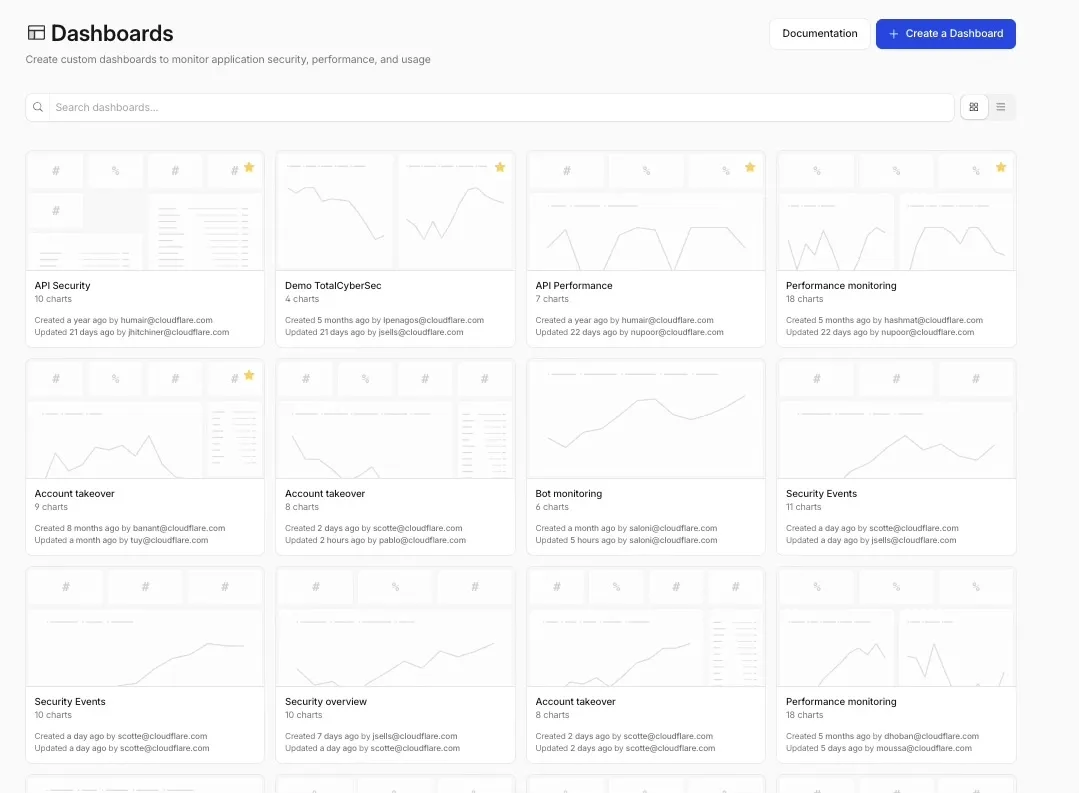
  • Analytics, Log Explorer – Custom dashboards available to all customers

    Custom Dashboards are now available to all Cloudflare customers. Build personalized views that highlight the metrics most critical to your infrastructure and security posture, moving beyond standard product dashboards.

    This update significantly expands the data available for visualization. Build charts based on any of the 100+ datasets available via the Cloudflare GraphQL API, covering everything from WAF events and Workers metrics to Load Balancing and Zero Trust logs.

    Log Explorer integration

    For Log Explorer customers, you can now turn raw log queries directly into dashboard charts. When you identify a specific pattern or spike while investigating logs, save that query as a visualization to monitor those signals in real-time without leaving the dashboard.

    Key benefits

    • Unified visibility: Consolidate signals from different Cloudflare products (for example, HTTP Traffic and R2 Storage) into a single view.
    • Flexible monitoring: Create charts that focus on specific status codes, ASN regions, or security actions that matter to your business.
    • Expanded limits: Log Explorer customers can create up to 100 dashboards (up from 25 for standard customers).

    Custom Dashboards home page showing dashboard list and chart previews

    To get started, refer to the Custom Dashboards documentation.

  • R2 – R2 Data Catalog snapshot expiration now removes unreferenced data files

    R2 Data Catalog, a managed Apache Iceberg catalog built into R2, now removes unreferenced data files during automatic snapshot expiration. This improvement reduces storage costs and eliminates the need to run manual maintenance jobs to reclaim space from deleted data.

    Previously, snapshot expiration only cleaned up Iceberg metadata files such as manifests and manifest lists. Data files that were no longer referenced by active snapshots remained in R2 storage until you manually ran remove_orphan_files or expire_snapshots through an engine like Spark. This required extra operational overhead and left stale data files consuming storage.

    Snapshot expiration now handles both metadata and data file cleanup automatically. When a snapshot is expired, any data files that are no longer referenced by retained snapshots are removed from R2 storage.

    # Enable catalog-level snapshot expiration
    npx wrangler r2 bucket catalog snapshot-expiration enable my-bucket
    --older-than-days 7
    --retain-last 10

    To learn more about snapshot expiration and other automatic maintenance operations, refer to the table maintenance documentation.