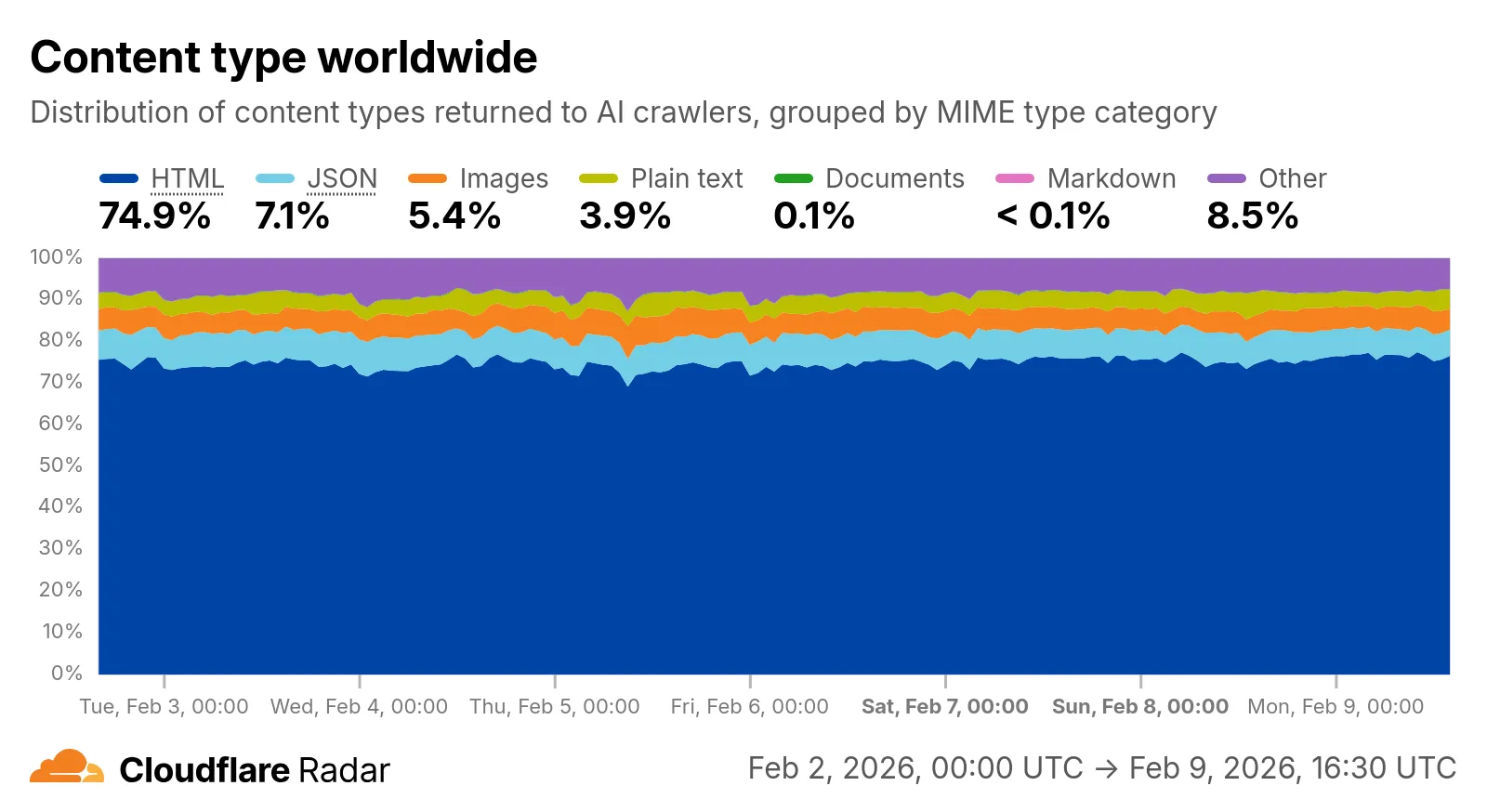
Radar now includes content type insights for AI bot and crawler traffic. The new content_type dimension and filter shows the distribution of content types returned to AI crawlers, grouped by MIME type category.
The content type dimension and filter are available via the following API endpoints:
Serialization – Binary API formats (application/protobuf, application/grpc, application/msgpack)
Other – All other content types
Additionally, individual bot information pages now display content type distribution for AI crawlers that exist in both the Verified Bots and AI Bots datasets.
Cloudflare’s network now supports real-time content conversion at the source, for enabled zones using content negotiation headers. When AI systems request pages from any website that uses Cloudflare and has Markdown for Agents enabled, they can express the preference for text/markdown in the request: our network will automatically and efficiently convert the HTML to markdown, when possible, on the fly.
Here is a curl example with the Accept negotiation header requesting this page from our developer documentation:
Radar now includes content type insights for AI bot and crawler traffic. The new content_type dimension and filter shows the distribution of content types returned to AI crawlers, grouped by MIME type category.
The content type dimension and filter are available via the following API endpoints:
Serialization – Binary API formats (application/protobuf, application/grpc, application/msgpack)
Other – All other content types
Additionally, individual bot information pages now display content type distribution for AI crawlers that exist in both the Verified Bots and AI Bots datasets.
Cloudflare’s network now supports real-time content conversion at the source, for enabled zones using content negotiation headers. When AI systems request pages from any website that uses Cloudflare and has Markdown for Agents enabled, they can express the preference for text/markdown in the request: our network will automatically and efficiently convert the HTML to markdown, when possible, on the fly.
Here is a curl example with the Accept negotiation header requesting this page from our developer documentation:
Radar now includes content type insights for AI bot and crawler traffic. The new content_type dimension and filter shows the distribution of content types returned to AI crawlers, grouped by MIME type category.
The content type dimension and filter are available via the following API endpoints:
Serialization – Binary API formats (application/protobuf, application/grpc, application/msgpack)
Other – All other content types
Additionally, individual bot information pages now display content type distribution for AI crawlers that exist in both the Verified Bots and AI Bots datasets.
Cloudflare’s network now supports real-time content conversion at the source, for enabled zones using content negotiation headers. When AI systems request pages from any website that uses Cloudflare and has Markdown for Agents enabled, they can express the preference for text/markdown in the request: our network will automatically and efficiently convert the HTML to markdown, when possible, on the fly.
Here is a curl example with the Accept negotiation header requesting this page from our developer documentation:
A childEnvironments option has been added to the plugin config to enable using multiple environments within a single Worker.
The parent environment can then import modules from a child environment in order to access a separate module graph.
For a typical RSC use case, the plugin might be configured as in the following example:
exportdefaultdefineConfig({
plugins: [
cloudflare({
viteEnvironment:{
name:"rsc",
childEnvironments: ["ssr"],
},
}),
],
});
@vitejs/plugin-rsc provides the lower level functionality that frameworks, such as React Router, build upon.
The GitHub repository includes a basic Cloudflare example.
The latest release of the Agents SDK brings readonly connections, MCP protocol and security improvements, x402 payment protocol v2 migration, and the ability to customize OAuth for MCP server connections.
Readonly connections
Agents can now restrict WebSocket clients to read-only access, preventing them from modifying agent state. This is useful for dashboards, spectator views, or any scenario where clients should observe but not mutate.
New hooks: shouldConnectionBeReadonly, setConnectionReadonly, isConnectionReadonly. Readonly connections block both client-side setState() and mutating @callable() methods, and the readonly flag survives hibernation.
JavaScript
classMyAgentextendsAgent{
shouldConnectionBeReadonly(connection){
// Make spectators readonly
returnconnection.url.includes("spectator");
}
}
TypeScript
classMyAgentextendsAgent{
shouldConnectionBeReadonly(connection){
// Make spectators readonly
returnconnection.url.includes("spectator");
}
}
Custom MCP OAuth providers
The new createMcpOAuthProvider method on the Agent class allows subclasses to override the default OAuth provider used when connecting to MCP servers. This enables custom authentication strategies such as pre-registered client credentials or mTLS, beyond the built-in dynamic client registration.
Upgraded the MCP SDK to 1.26.0 to prevent cross-client response leakage. Stateless MCP Servers should now create a new McpServer instance per request instead of sharing a single instance. A guard is added in this version of the MCP SDK which will prevent connection to a Server instance that has already been connected to a transport. Developers will need to modify their code if they declare their McpServer instance as a global variable.
MCP OAuth callback URL security fix
Added callbackPath option to addMcpServer to prevent instance name leakage in MCP OAuth callback URLs. When sendIdentityOnConnect is false, callbackPath is now required — the default callback URL would expose the instance name, undermining the security intent. Also fixes callback request detection to match via the state parameter instead of a loose /callback URL substring check, enabling custom callback paths.
Deprecate onStateUpdate in favor of onStateChanged
onStateChanged is a drop-in rename of onStateUpdate (same signature, same behavior). onStateUpdate still works but emits a one-time console warning per class. validateStateChange rejections now propagate a CF_AGENT_STATE_ERROR message back to the client.
x402 v2 migration
Migrated the x402 MCP payment integration from the legacy x402 package to @x402/core and @x402/evm v2.
Breaking changes for x402 users:
Peer dependencies changed: replace x402 with @x402/core and @x402/evm
PaymentRequirements type now uses v2 fields (e.g. amount instead of maxAmountRequired)
X402ClientConfig.account type changed from viem.Account to ClientEvmSigner (structurally compatible with privateKeyToAccount())
npmuninstallx402
npminstall@x402/core@x402/evm
Network identifiers now accept both legacy names and CAIP-2 format:
// Legacy name (auto-converted)
{
network:"base-sepolia",
}
// CAIP-2 format (preferred)
{
network:"eip155:84532",
}
Other x402 changes:
X402ClientConfig.network is now optional — the client auto-selects from available payment requirements
Server-side lazy initialization: facilitator connection is deferred until the first paid tool invocation
Payment tokens support both v2 (PAYMENT-SIGNATURE) and v1 (X-PAYMENT) HTTP headers
Added normalizeNetwork export for converting legacy network names to CAIP-2 format
Re-exports PaymentRequirements, PaymentRequired, Network, FacilitatorConfig, and ClientEvmSigner from agents/x402
Other improvements
Fix useAgent and AgentClient crashing when using basePath routing
CORS handling delegated to partyserver’s native support (simpler, more reliable)
Client-side onStateUpdateError callback for handling rejected state updates
Each session can have its own terminal with an isolated working directory and environment, so users can run separate shells side-by-side in the same container.
JavaScript
// Multiple isolated terminals in the same sandbox
constdev=awaitsandbox.getSession("dev");
returndev.terminal(request);
TypeScript
// Multiple isolated terminals in the same sandbox
constdev=awaitsandbox.getSession("dev");
returndev.terminal(request);
xterm.js addon
The new @cloudflare/sandbox/xterm export provides a SandboxAddon for xterm.js with automatic reconnection (exponential backoff + jitter), buffered output replay, and resize forwarding.
JavaScript
import {SandboxAddon} from "@cloudflare/sandbox/xterm";
constaddon=newSandboxAddon({
getWebSocketUrl:({sandboxId,origin})=>
`${origin}/ws/terminal?id=${sandboxId}`,
onStateChange:(state,error)=>updateUI(state),
});
terminal.loadAddon(addon);
addon.connect({ sandboxId:"my-sandbox"});
TypeScript
import {SandboxAddon} from "@cloudflare/sandbox/xterm";