Gateway Protocol Detection now supports seven additional protocols in beta:
Protocol
Notes
IMAP
Internet Message Access Protocol — email retrieval
POP3
Post Office Protocol v3 — email retrieval
SMTP
Simple Mail Transfer Protocol — email sending
MYSQL
MySQL database wire protocol
RSYNC-DAEMON
rsync daemon protocol
LDAP
Lightweight Directory Access Protocol
NTP
Network Time Protocol
These protocols join the existing set of detected protocols (HTTP, HTTP2, SSH, TLS, DCERPC, MQTT, and TPKT) and can be used with the Detected Protocol selector in Network policies to identify and filter traffic based on the application-layer protocol, without relying on port-based identification.
If protocol detection is enabled on your account, these protocols will automatically be logged when detected in your Gateway network traffic.
Cloudflare’s stale-while-revalidate support is now fully asynchronous. Revalidation begins at expiry rather than waiting for the next visitor request. Stale content is served immediately while Cloudflare refreshes the asset in the background, and no visitor has to wait for an origin round-trip.
stale-while-revalidate is a Cache-Control directive that allows Cloudflare to serve an expired cached asset while a fresh copy is fetched from the origin.
Asynchronous revalidation brings:
Lower latency: The first visitor is no longer blocked while the asset is updated from the origin, providing a faster experience.
Fresher content: Assets are revalidated sooner, and visitors are more likely to receive up-to-date content.
Note that your origin may see an increase in traffic due to revalidation on expiry. In addition, all revalidation cache statuses are now UPDATING or HIT instead of MISS or REVALIDATED.
Availability
This change is live for all Free, Pro, and Business zones. Approximately 75% of Enterprise zones have been migrated, with the remaining zones rolling out throughout the quarter.
Get started
To use this feature, make sure your origin includes the stale-while-revalidate directive in the Cache-Control header. Refer to the Cache-Control documentation for details.
The latest release of the Agents SDK lets you define an Agent and an McpAgent in the same Worker and connect them over RPC — no HTTP, no network overhead. It also makes OAuth opt-in for simple MCP connections, hardens the schema converter for production workloads, and ships a batch of @cloudflare/ai-chat reliability fixes.
RPC transport for MCP
You can now connect an Agent to an McpAgent in the same Worker using a Durable Object binding instead of an HTTP URL. The connection stays entirely within the Cloudflare runtime — no network round-trips, no serialization overhead.
Pass the Durable Object namespace directly to addMcpServer:
JavaScript
import {Agent} from "agents";
exportclassMyAgentextendsAgent{
asynconStart(){
// Connect via DO binding — no HTTP, no network overhead
awaitthis.addMcpServer("counter",env.MY_MCP);
// With props for per-user context
awaitthis.addMcpServer("counter",env.MY_MCP,{
props:{ userId:"user-123", role:"admin"},
});
}
}
TypeScript
import {Agent} from "agents";
exportclassMyAgentextendsAgent{
asynconStart(){
// Connect via DO binding — no HTTP, no network overhead
awaitthis.addMcpServer("counter",env.MY_MCP);
// With props for per-user context
awaitthis.addMcpServer("counter",env.MY_MCP,{
props:{ userId:"user-123", role:"admin"},
});
}
}
The addMcpServer method now accepts string | DurableObjectNamespace as the second parameter with full TypeScript overloads, so HTTP and RPC paths are type-safe and cannot be mixed.
Key capabilities:
Hibernation support — RPC connections survive Durable Object hibernation automatically. The binding name and props are persisted to storage and restored on wake-up, matching the behavior of HTTP MCP connections.
Deduplication — Calling addMcpServer with the same server name returns the existing connection instead of creating duplicates. Connection IDs are stable across hibernation restore.
Smaller surface area — The RPC transport internals have been rewritten and reduced from 609 lines to 245 lines. RPCServerTransport now uses JSONRPCMessageSchema from the MCP SDK for validation instead of hand-written checks.
Optional OAuth for MCP connections
addMcpServer() no longer eagerly creates an OAuth provider for every connection. For servers that do not require authentication, a simple call is all you need:
If the server responds with a 401, the SDK throws a clear error: "This MCP server requires OAuth authentication. Provide callbackHost in addMcpServer options to enable the OAuth flow." The restore-from-storage flow also handles missing callback URLs gracefully, skipping auth provider creation for non-OAuth servers.
Hardened JSON Schema to TypeScript converter
The schema converter used by generateTypes() and getAITools() now handles edge cases that previously caused crashes in production:
Depth and circular reference guards — Prevents stack overflows on recursive or deeply nested schemas
Tuple support — prefixItems (JSON Schema 2020-12) and array items (draft-07)
OpenAPI 3.0 nullable: true — Supported across all schema branches
Per-tool error isolation — One malformed schema cannot crash the full pipeline in generateTypes() or getAITools()
Missing inputSchema fallback — getAITools() falls back to { type: "object" } instead of throwing
@cloudflare/ai-chat fixes
Tool denial flow — Denied tool approvals (approved: false) now transition to output-denied with a tool_result, fixing Anthropic provider compatibility. Custom denial messages are supported via state: "output-error" and errorText.
Abort/cancel support — Streaming responses now properly cancel the reader loop when the abort signal fires and send a done signal to the client.
Duplicate message persistence — persistMessages() now reconciles assistant messages by content and order, preventing duplicate rows when clients resend full history.
requestId in OnChatMessageOptions — Handlers can now send properly-tagged error responses for pre-stream failures.
redacted_thinking preservation — The message sanitizer no longer strips Anthropic redacted_thinking blocks.
/get-messages reliability — Endpoint handling moved from a prototype onRequest() override to a constructor wrapper, so it works even when users override onRequest without calling super.onRequest().
Client tool APIs undeprecated — createToolsFromClientSchemas, clientTools, AITool, extractClientToolSchemas, and the tools option on useAgentChat are restored for SDK use cases where tools are defined dynamically at runtime.
jsonSchema initialization — Fixed jsonSchema not initialized error when calling getAITools() in onChatMessage.
You can now run more Containers concurrently with significantly higher limits on memory, vCPU, and disk.
Limit
Previous Limit
New Limit
Memory for concurrent live Container instances
400GiB
6TiB
vCPU for concurrent live Container instances
100
1,500
Disk for concurrent live Container instances
2TB
30TB
This 15x increase enables larger-scale workloads on Containers. You can now run 15,000 instances of the lite instance type, 6,000 instances of basic, over 1,500 instances of standard-1, or over 1,000 instances of standard-2 concurrently.
Refer to Limits for more details on the available instance types and limits.
Pywrangler, the CLI tool for managing Python Workers and packages,
now supports Windows, allowing you to develop and deploy Python Workers from Windows environments.
Previously, Pywrangler was only available on macOS and Linux.
You can install and use Pywrangler on Windows the same way you would on other platforms. Specify your Worker’s Python dependencies in your pyproject.toml file,
then use the following commands to develop and deploy:
uvx--fromworkers-pypywranglerdev
uvx--fromworkers-pypywranglerdeploy
All existing Pywrangler functionality, including package management, local development, and deployment, works on Windows without any additional configuration.
Requirements
This feature requires the following minimum versions:
wrangler >= 4.64.0
workers-py >= 1.72.0
uv >= 0.29.8
To upgrade workers-py (which includes Pywrangler) in your project, run:
uvtoolupgradeworkers-py
To upgrade wrangler, run:
npminstall-gwrangler@latest
To upgrade uv, run:
uvselfupdate
To get started with Python Workers on Windows, refer to the Python packages documentation for full details on Pywrangler.
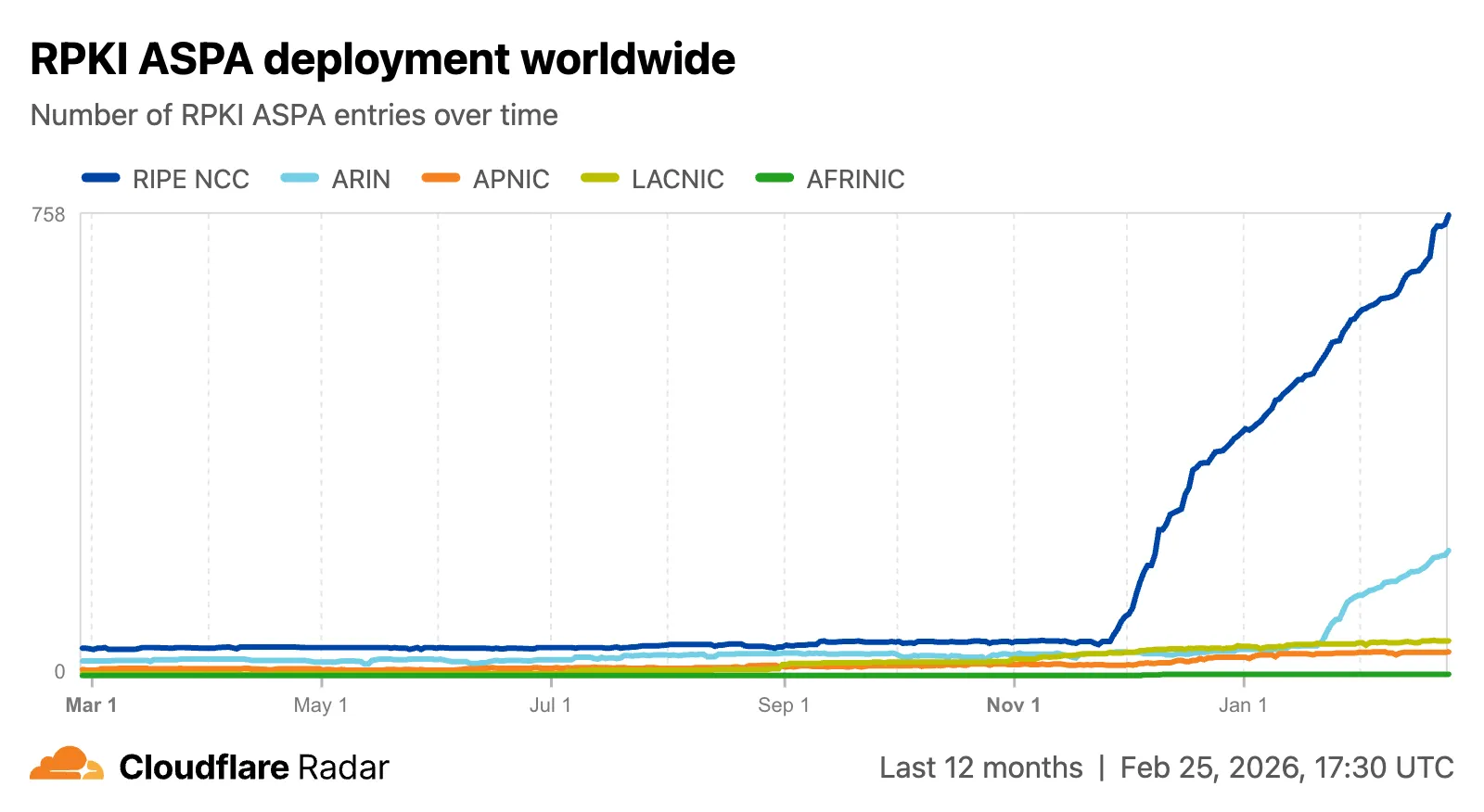
The global routing page now shows the ASPA deployment trend over time by counting daily ASPA objects.
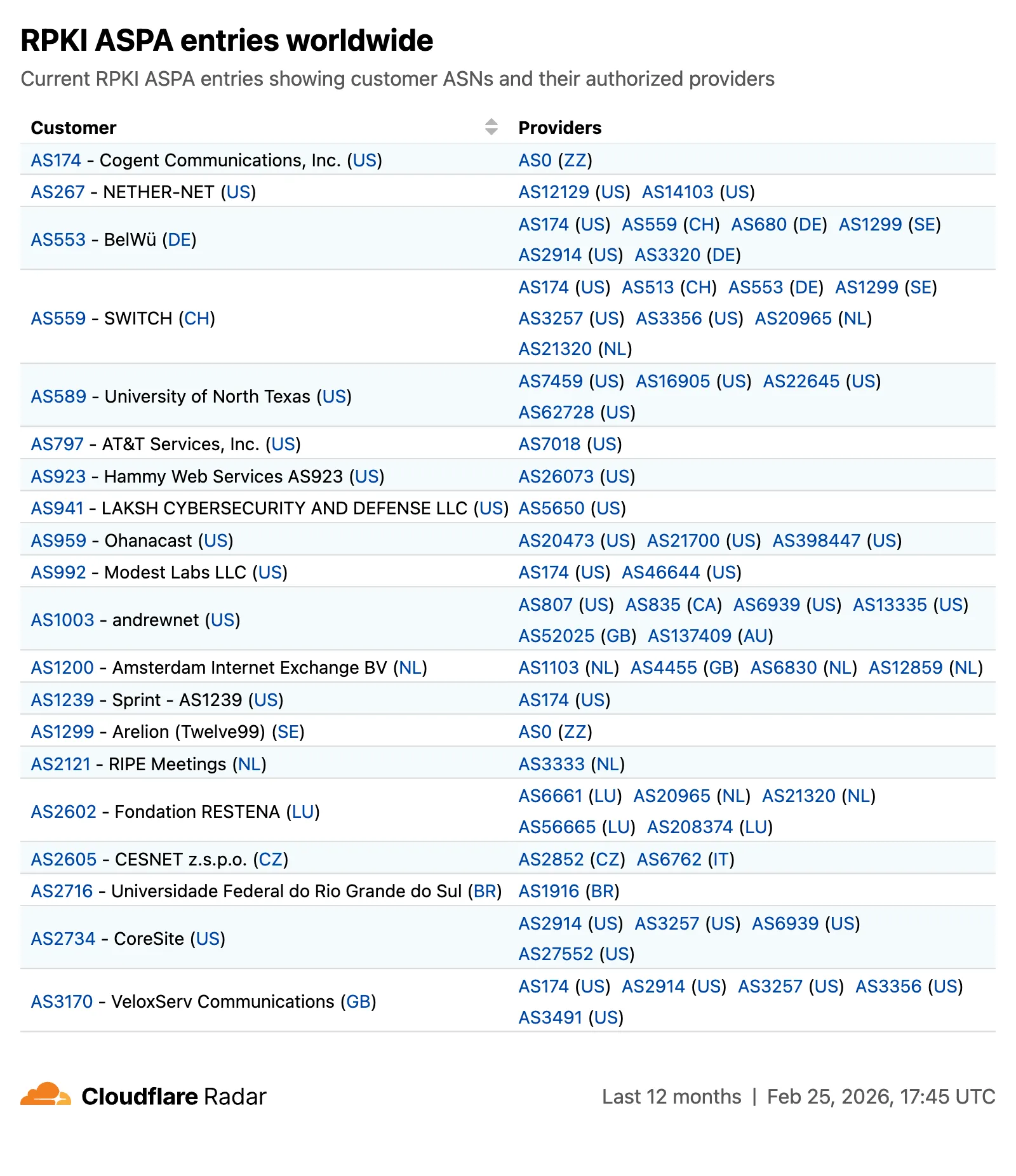
The global routing page also displays the most recent ASPA objects, searchable by ASN or AS name.
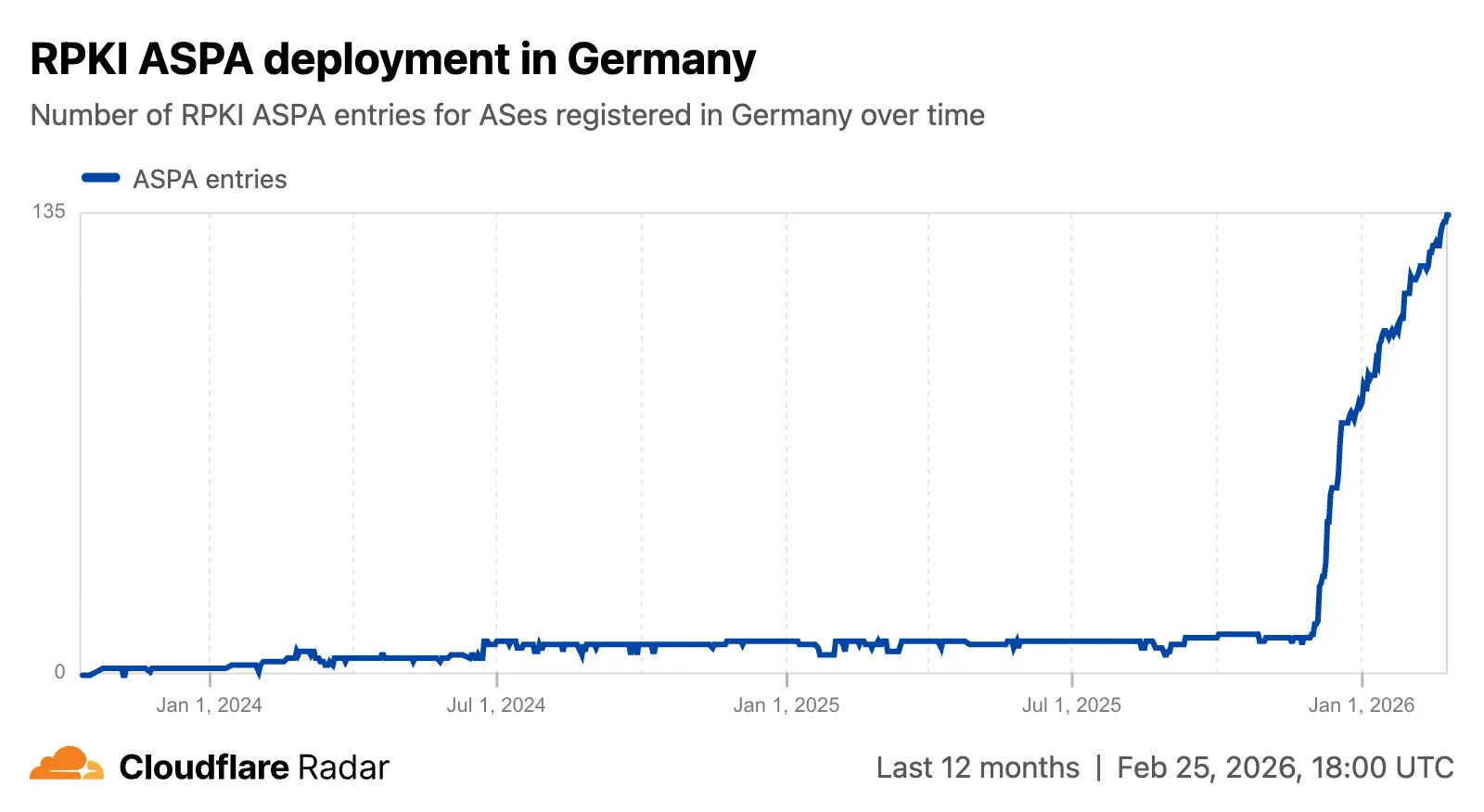
On country and region routing pages, a new widget shows the ASPA deployment rate for ASNs registered in the selected country or region.
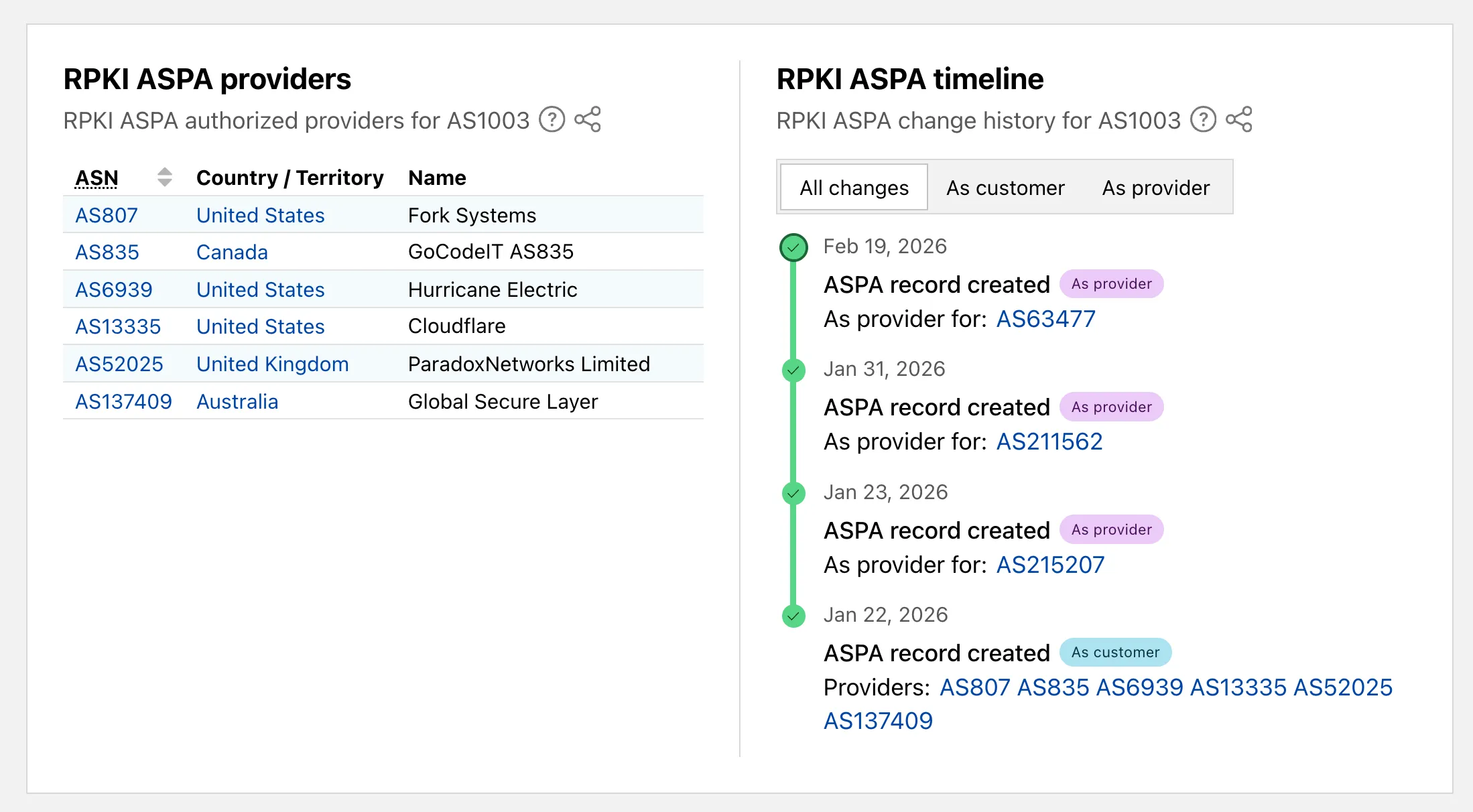
On AS routing pages, the connectivity table now includes checkmarks for ASPA-verified upstreams. All ASPA upstreams are listed in a dedicated table, and a timeline shows ASPA changes at daily granularity.
This release contains minor fixes, improvements, and new features.
Changes and improvements
Improvements to multi-user mode. Fixed an issue where when switching from a pre-login registration to a user registration, Mobile Device Management (MDM) configuration association could be lost.
Added a new feature to manage NetBIOS over TCP/IP functionality on the Windows client. NetBIOS over TCP/IP on the Windows client is now disabled by default and can be enabled in device profile settings.
Fixed an issue causing failure of the local network exclusion feature when configured with a timeout of 0.
Improvement for the Windows client certificate posture check to ensure logged results are from checks that run once users log in.
Improvement for more accurate reporting of device colocation information in the Cloudflare One dashboard.
Fixed an issue where misconfigured DEX HTTP tests prevented new registrations.
Fixed an issue causing DNS requests to fail with clients in Traffic and DNS mode.
Improved service shutdown behavior in cases where the daemon is unresponsive.
Known issues
For Windows 11 24H2 users, Microsoft has confirmed a regression that may lead to performance issues like mouse lag, audio cracking, or other slowdowns. Cloudflare recommends users experiencing these issues upgrade to a minimum Windows 11 24H2 KB5062553 or higher for resolution.
Devices with KB5055523 installed may receive a warning about Win32/ClickFix.ABA being present in the installer. To resolve this false positive, update Microsoft Security Intelligence to version 1.429.19.0 or later.
DNS resolution may be broken when the following conditions are all true:
WARP is in Secure Web Gateway without DNS filtering (tunnel-only) mode.
A custom DNS server address is configured on the primary network adapter.
The custom DNS server address on the primary network adapter is changed while WARP is connected.
To work around this issue, reconnect the WARP client by toggling off and back on.
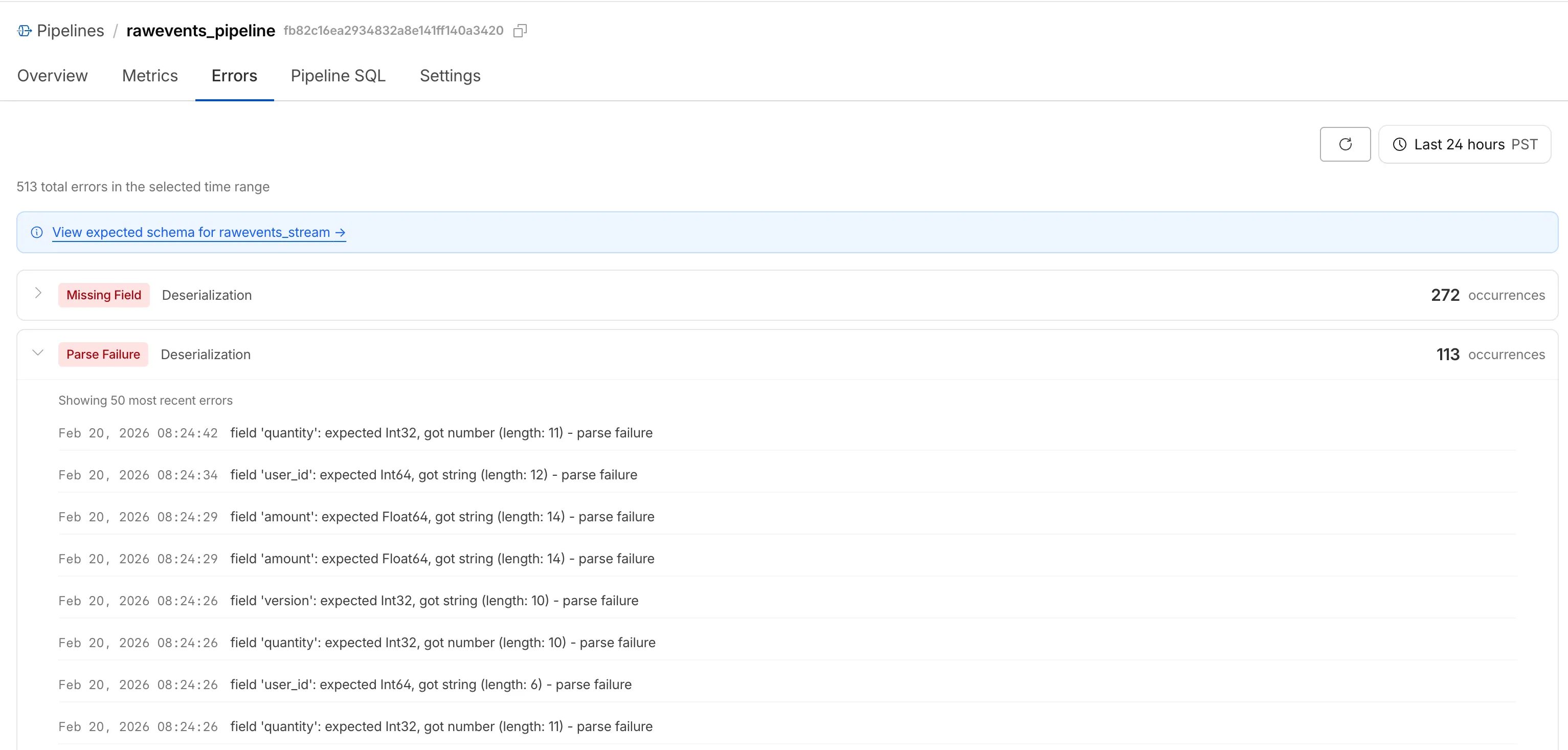
Cloudflare Pipelines ingests streaming data via Workers or HTTP endpoints, transforms it with SQL, and writes it to R2 as Apache Iceberg tables. Today we’re shipping three improvements to help you understand why streaming events get dropped, catch data quality issues early, and set up Pipelines faster.
Dropped event metrics
When stream events don’t match the expected schema, Pipelines accepts them during ingestion but drops them when attempting to deliver them to the sink. To help you identify the root cause of these issues, we are introducing a new dashboard and metrics that surface dropped events with detailed error messages.
Dropped events can also be queried programmatically via the new pipelinesUserErrorsAdaptiveGroups GraphQL dataset. The dataset breaks down failures by specific error type (missing_field, type_mismatch, parse_failure, or null_value) so you can trace issues back to the source.
queryGetPipelineUserErrors(
$accountTag:String!
$pipelineId:String!
$datetimeStart:Time!
$datetimeEnd:Time!
) {
viewer {
accounts(filter: { accountTag: $accountTag }) {
pipelinesUserErrorsAdaptiveGroups(
limit:100
filter: {
pipelineId: $pipelineId
datetime_geq: $datetimeStart
datetime_leq: $datetimeEnd
}
orderBy: [count_DESC]
) {
count
dimensions {
errorFamily
errorType
}
}
}
}
}
For the full list of dimensions, error types, and additional query examples, refer to User error metrics.
Typed Pipelines bindings
Sending data to a Pipeline from a Worker previously used a generic Pipeline<PipelineRecord> type, which meant schema mismatches (wrong field names, incorrect types) were only caught at runtime as dropped events.
Running wrangler types now generates schema-specific TypeScript types for your Pipeline bindings. TypeScript catches missing required fields and incorrect field types at compile time, before your code is deployed.
Setting up a new Pipeline previously required multiple manual steps: creating an R2 bucket, enabling R2 Data Catalog, generating an API token, and configuring format, compression, and rolling policies individually.
The wrangler pipelines setup command now offers a Simple setup mode that applies recommended defaults and automatically creates the R2 bucket and enables R2 Data Catalog if they do not already exist. Validation errors during setup prompt you to retry inline rather than restarting the entire process.
deleteAll() now deletes a Durable Object alarm in addition to stored data for Workers with a compatibility date of 2026-02-24 or later. This change simplifies clearing a Durable Object’s storage with a single API call.
Previously, deleteAll() only deleted user-stored data for an object. Alarm usage stores metadata in an object’s storage, which required a separate deleteAlarm() call to fully clean up all storage for an object. The deleteAll() change applies to both KV-backed and SQLite-backed Durable Objects.
// Before: two API calls required to clear all storage
awaitthis.ctx.storage.deleteAlarm();
awaitthis.ctx.storage.deleteAll();
// Now: a single call clears both data and the alarm